

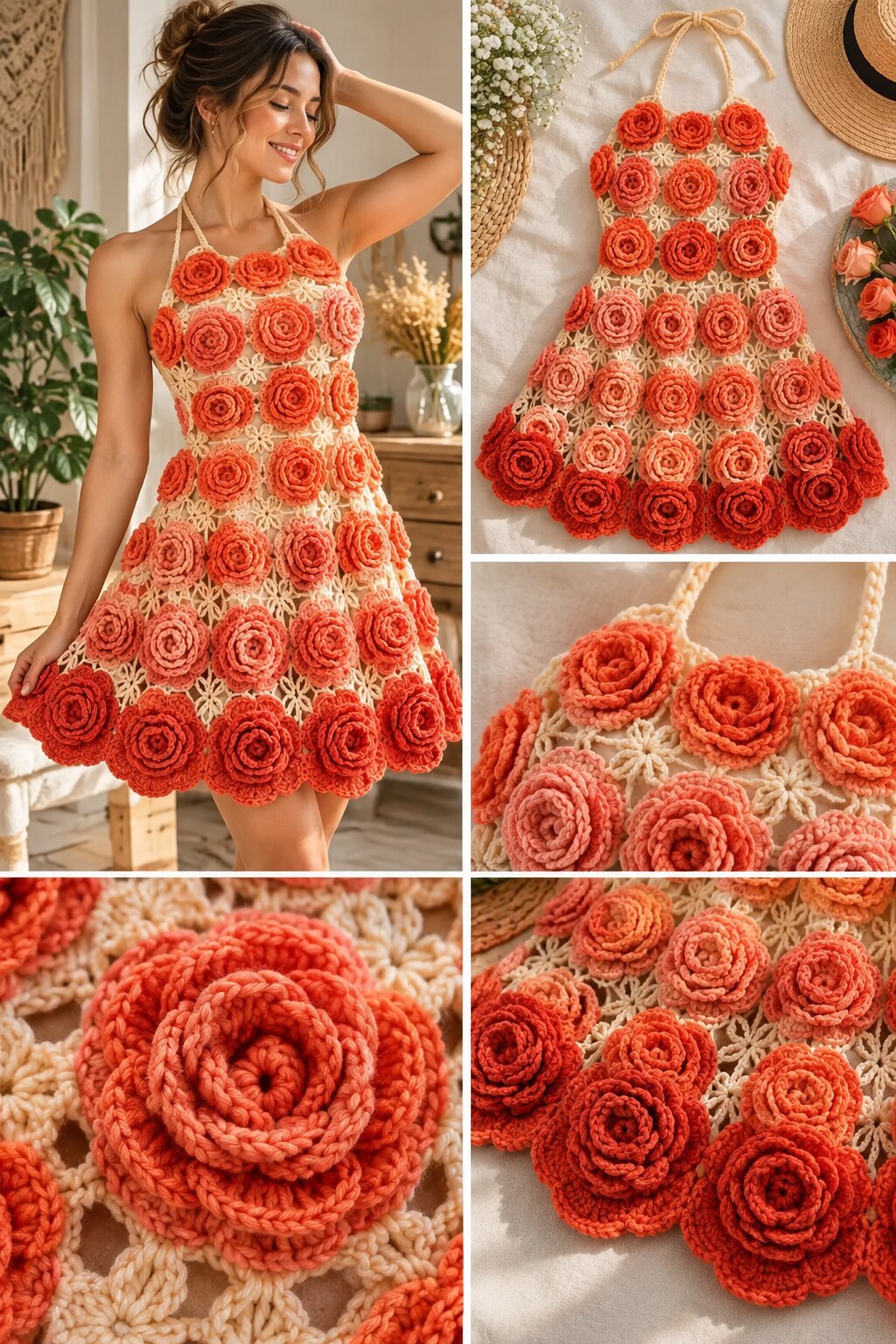
Every visible surface of this dress is roses. Not a few scattered motifs with open fabric between them — actual rows of fully bloomed crochet roses, packed edge to edge, covering the entire bodice and skirt from the halter neckline down to the hem. A cream mesh background peeks through only in the thin gaps between flowers, more structural than decorative. The color isn’t flat either — it shifts row by row, starting in a deeper terracotta-red near the shoulders, moving through coral and a softer dusty pink through the midsection, and landing back in a richer burnt orange-red at the hem.
This is a fully flared, above-the-knee A-line shape, built on simple braided cord ties at the neck rather than anything structured. What makes it worth studying isn’t the silhouette, which is a standard halter mini — it’s the sheer density of three-dimensional motif work. Every single rose had to be made individually, then joined into the mesh base in careful rows, with the color sequencing planned out before a single flower was attached.
This is not a weekend project, and it’s not trying to be. It’s for someone who already enjoys making crocheted roses on their own and wants a reason to make several dozen of them for one cohesive piece.
What’s Actually Involved Here
Look at the base fabric between the roses and you can see it’s a simple open mesh, likely a basic chain-space grid rather than anything elaborate — which makes sense, since the base is never meant to be the visual focus. It only needs to hold the roses in place and give the dress its underlying shape.
The roses themselves look like they’re built from spiral or layered petal rounds, worked flat and then likely cupped or gathered slightly at the center to get that coiled, blooming look rather than a flat flower shape. Getting that same dimensional curl is really the core skill this whole project depends on — once you can make one rose look right, the rest of the dress is repetition and color planning rather than new techniques.
The color gradient running through the rows isn’t random. It reads as a deliberate near-to-far progression: richer, darker tones concentrated at the shoulders and again at the hem, with softer coral and pink in between. That kind of bookending is a common way to make a gradient feel intentional rather than like the yarn just ran out and got switched.
Materials You’ll Need
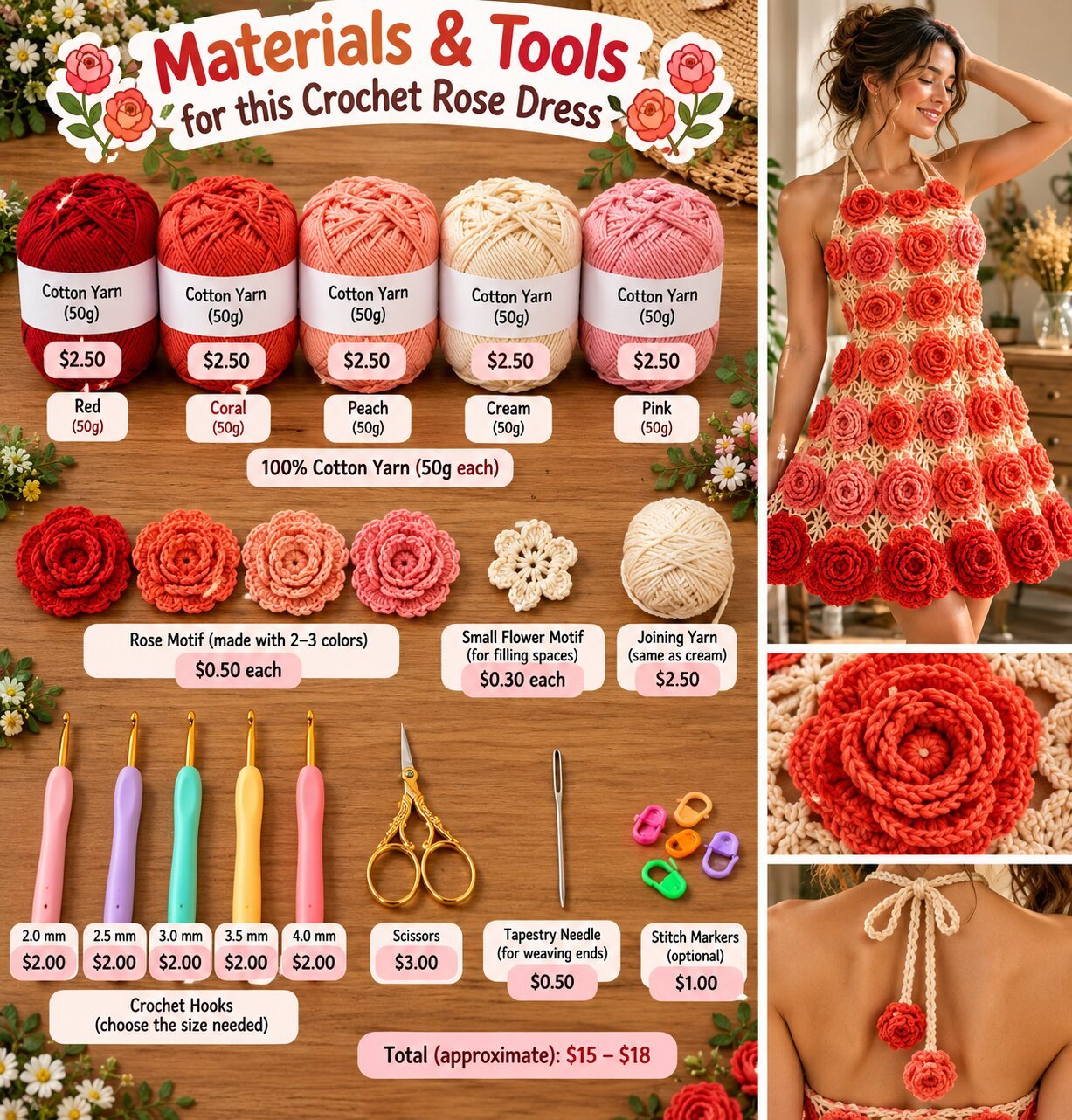
- Yarn in several coordinating warm shades — terracotta, coral, salmon pink, and burnt orange-red are what’s visible here (a cotton or cotton-blend yarn is a reasonable suggestion, since the rose petals hold a crisp, structured curl rather than flopping)
- Cream or ecru yarn for the mesh base
- A crochet hook sized to your yarn (see below)
- Yarn needle, for attaching dozens of individual roses
- Scissors
- Stitch markers, useful for keeping row placement and color changes aligned as you attach flowers
- A tape measure, since fit and length here depend on your own measurements rather than a printed chart
Yarn and Hook Notes
Given how tightly coiled and well-defined each rose looks, a DK or light worsted cotton is a sensible starting point — enough body to hold the spiral shape of the petals without the roses looking floppy or oversized relative to the dress. A hook somewhere in the 3mm to 4mm range is reasonable for that weight, though this is very much a project where you want to make one complete rose as a swatch first and check both its size and how it holds its shape before committing to producing enough for a full dress.
Buy more yarn than you think you’ll need in each shade. A project built from this many individual motifs is notoriously easy to underestimate on yardage, especially once you’re partway through and realize how many roses a single row actually requires.
Skill Level
This is an advanced project, and the difficulty isn’t really about any single stitch being hard. It’s about volume and consistency. You need to make a large number of roses that all look the same size and shape, manage a mesh base that needs to actually fit a body, and plan a color gradient across dozens of individual pieces so it reads as smooth rather than patchy. Someone who already knows how to make a dimensional crochet rose, but has never made more than a handful at once, will find the scale here is the real challenge.
Stitches Likely Involved
- Chain (ch) — the open mesh base and the halter ties
- Slip stitch (sl st) — joining mesh rounds and finishing each rose
- Single crochet (sc) and double crochet (dc) — building the simple grid of the base fabric
- A spiral or layered petal construction for the roses — worked as a long strip of increasing petal shapes, then rolled and tacked at the base to form the coiled bloom, which is a common technique for this exact rose style
- Increase (inc) — shaping the mesh base to flare out into the A-line skirt
Building It: A Practical Sequence
Make the mesh base first, shaped to your own body. Work it as a simple open grid from the halter neckline down, increasing steadily to create the A-line flare, and try it on periodically since there’s no chart to confirm sizing against.
Batch-produce the roses before you start attaching anything. Make far more than you think the first few rows will need, in each color, so you’re not stopping mid-assembly to crochet more flowers in a color you’ve run short on.
Plan your row-by-row color order on paper before attaching a single rose. Since the gradient needs to read smoothly across dozens of individual motifs, it’s much easier to adjust the plan on paper than to unpick flowers that are already stitched down.
Attach roses in horizontal rows, working from the neckline down. Keep spacing tight and consistent — the gaps between flowers in the reference photo are minimal, which is part of what makes the dress read as fully floral rather than as a mesh dress with flowers added on.
Overlap roses slightly where rows meet, rather than leaving a visible gap of bare mesh between one row and the next, which is what gives this dress its dense, no-background-visible look.
Finish the halter ties as simple braided or twisted cords, and weave in the considerable number of ends this project generates as you go rather than saving them all for the end.
Adjusting the Fit and Look
Length and flare both come down to how many rows of mesh and roses you add — stopping sooner gives a shorter hem, continuing longer extends it past the knee if preferred. Bust and waist fit depend on your own gauge swatch of the mesh base compared against your measurements, since no size chart exists for this.
If producing enough roses for full head-to-toe coverage feels unrealistic for a first attempt, using the roses only on the bodice and skirt hem while leaving the midsection in plain mesh would cut the flower count significantly while keeping the overall look recognizable.
Where It’s Easy to Go Wrong
Roses that vary noticeably in size. With this many flowers side by side, even a small size inconsistency between batches becomes obvious. Make all your roses using the same tension and petal count per round.
A gradient that looks accidental rather than planned. Switching colors without a row-by-row plan tends to produce a patchy result instead of the smooth, bookended gradient in the photo. Map it out before you start attaching.
Gaps of visible mesh between roses. If flowers are spaced too far apart, the dress reads as a mesh garment with flowers scattered on rather than a fully floral surface. Keep placement tight and overlapping.
Underestimating total rose count and yarn needed. This is the single most common way a project like this stalls out halfway. Overestimate both from the start.
Care
Hand washing in cool water and laying flat to dry is the safer approach, given how much dimensional texture this dress carries — a washing machine’s agitation risks flattening or distorting the rose petals. Avoid the dryer entirely, since heat can collapse the curled petal shapes that took the most effort to build. Check the specific yarn label for anything more particular to the fiber you used.
Common Questions
Is this a realistic project for someone newer to crochet?
Not as a first project. Making one rose well is approachable for most skill levels, but managing the volume and gradient planning for a full dress is a different scale of commitment.
How many roses does a dress like this actually need?
That depends entirely on your size and row count, but expect the number to be considerably higher than it looks from a quick glance at the photo — dense, edge-to-edge coverage adds up fast.
Can I use a single color instead of a gradient?
Yes, a monochrome version would still look full and dimensional, just without the sunset-style color movement that gives this particular dress its name.
Do I need to block anything here?
The mesh base would likely benefit from light blocking to even out the fit, though the roses themselves are shaped more by their own construction than by blocking.


1 thought on “Coral Sunset Floral Halter Dress Free Crochet Pattern”