
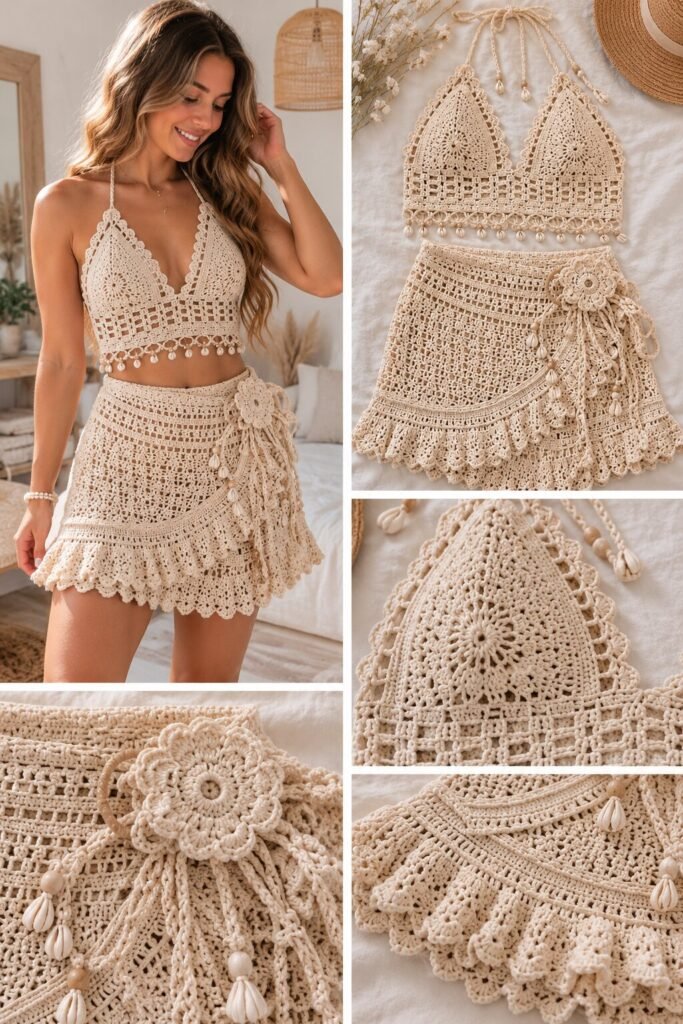
A triangle bralette top with a crochet flower center at each cup, finished in a scalloped edge and a row of dangling cowrie shells along the bottom band. Below it, a wrap-style mini skirt with a solid waistband, an open lattice body, and the same scalloped hem repeated at the bottom, plus a single larger crochet flower pinned at the hip where the wrap closes, trailing a cluster of shell and bead tassels down the thigh. Everything is one color — natural cream — so all the visual interest comes from texture and layered trim rather than contrast.
What stands out structurally is how many distinct elements are stacked into this one set. The bralette alone has a filet-mesh lower band, a more open fan-stitch triangle cup, a scalloped edge, and shell fringe at the halter ties. The skirt echoes that same scalloped trim at the hem and shares the lattice stitch in its body, which is what makes the two pieces read as a coordinated set rather than two separate projects that happen to match in color.
This is a reasonable project for someone who already has a finished crochet bralette or two behind them and wants to pair it with something more involved — the skirt’s wrap closure and the shell/tassel embellishments at the hip are the real new skills here.
Reading the Construction
The bralette cups look like they start from a center point and build outward in a fan or shell stitch, the classic way a triangle bikini or bralette top is worked, then transition into an open filet grid for the lower band that sits against the ribs. That band is doing a practical job — the mesh gives it some stretch and breathability right under the bust, where a solid stitch would feel more restrictive.
The skirt’s main body uses a similar open filet lattice to the bralette’s lower band, which is part of why the two pieces feel connected rather than coincidentally the same color. The waistband, by contrast, looks like a denser solid stitch, giving the skirt some structure at the top before it opens into the looser lattice below.
The big crochet flower at the hip is clearly a separate motif, probably worked flat in rounds with increasing petal layers, then stitched onto the skirt rather than built into the wrap construction directly. The shell and bead tassels hanging from it appear to be separate cords threaded with actual shell beads or crocheted bead-wrapped tips, tied or sewn in at the same point as the flower.
Materials You’ll Need
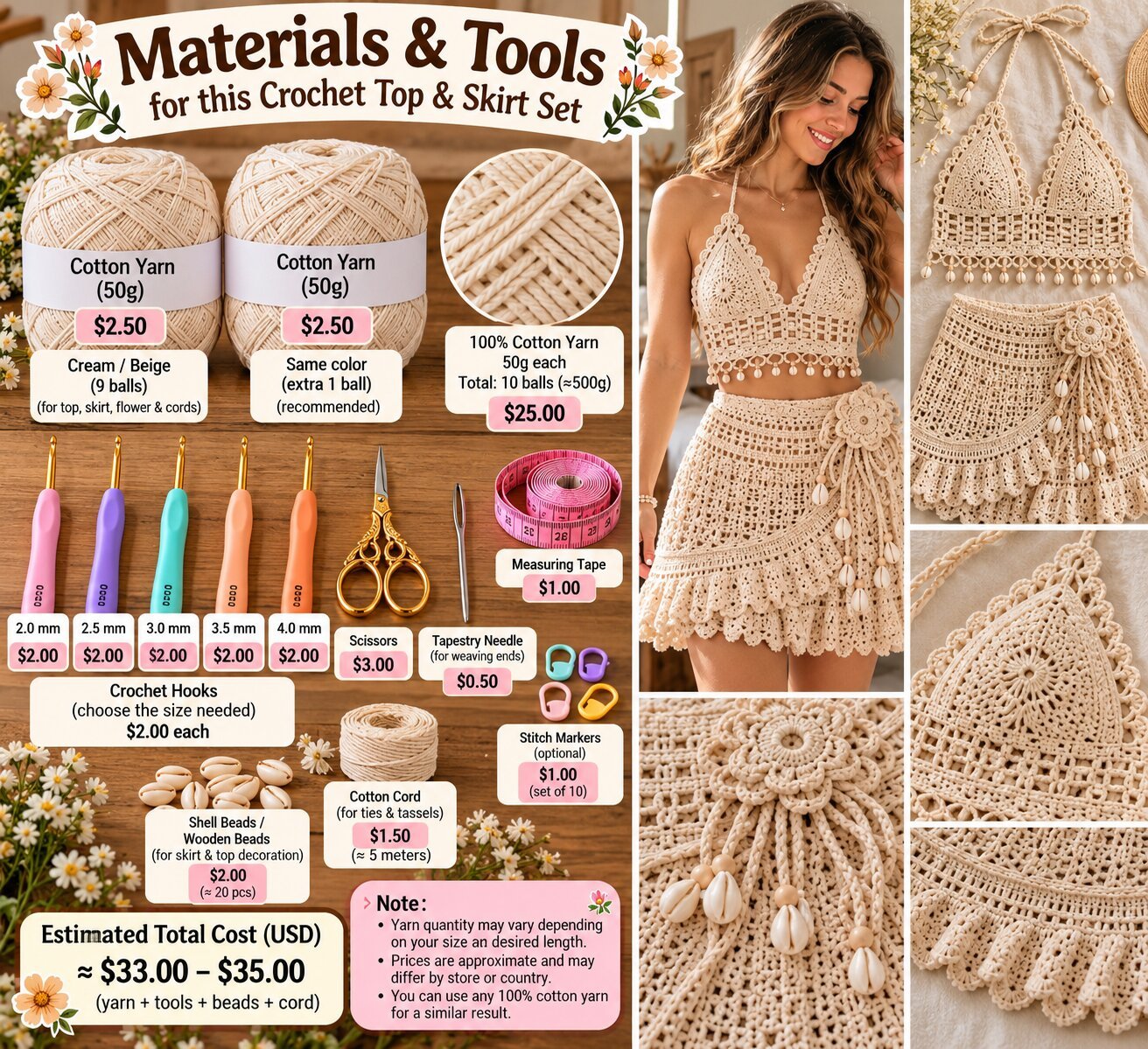
- Natural or cream-colored yarn, since the whole set depends on tonal texture rather than color contrast (a cotton or cotton-blend yarn in a fine to medium weight is a reasonable suggestion, based on how crisp the lattice and scalloped stitches look)
- A crochet hook sized to your yarn (see below)
- Yarn needle, for attaching the flower motif and finishing seams
- Scissors
- Small shells with pre-drilled holes, or shell-style beads, for the fringe detail
- Wooden or natural beads, if you want to echo the mixed bead-and-shell tassels visible at the hip
- Cord or extra yarn for threading the shell fringe
- A tape measure, since fit for both pieces depends on your own measurements
Yarn and Hook Notes
Given how fine and detailed the fan stitch on the bralette cups looks, along with the tight, even filet grid throughout, a lighter weight cotton — something in the fingering to light DK range — is a sensible starting point. A hook somewhere around 2.5mm to 3.5mm is reasonable for that weight, though the filet sections specifically might benefit from a slightly tighter gauge than the fan-stitch cups to keep the grid crisp rather than floppy.
Cotton is worth prioritizing here over a looser natural fiber like a raffia blend — while raffia-style yarns are common in boho crochet, the fine detail in the scalloped edges and the flower motif suggests a yarn with more consistent stitch definition than raffia typically offers.
Skill Level
This is an intermediate to advanced project, mainly because of the number of separate techniques involved rather than any one being especially hard. The triangle bralette cups, the filet mesh, the scalloped edging, the wrap-skirt construction, and the separate flower motif with its own embellishment all need to come together into one cohesive set. Someone who’s made a bralette before will find that part familiar, but the wrap skirt with its shell and bead fringe is a genuinely new combination of skills.
Stitches Likely Involved
- Chain (ch) — the filet mesh grid and the halter ties
- Slip stitch (sl st) — joining rounds and finishing the scalloped edges
- Single crochet (sc) and double crochet (dc) — alternating to build the filet grid throughout both pieces
- Shell or fan stitch — the triangle bralette cups, and likely the scalloped trim repeated at both hems
- A layered flower motif, worked in the round with increasing petal layers for the larger flower at the hip
- Increase (inc) — shaping the skirt’s wrap panel wide enough to overlap at the front
Building It: A Practical Sequence
Start the bralette cups from the point, working the fan or shell stitch outward in rounds or rows to build the triangle shape, then transition to the filet grid for the lower band once the cups reach the width you need.
Add the scalloped edge around the entire bralette once the main shape is complete, and finish with halter ties long enough to tie behind the neck and around the ribs, adding the shell drops at the tie ends last.
Work the skirt waistband as a solid, fitted band first, sized to your own waist measurement, since this is the one part of the skirt that needs to sit snugly rather than drape loosely.
Build the main lattice body of the skirt as a wrap panel, wide enough to overlap generously at the front rather than meeting edge to edge — a true wrap skirt needs significant overlap to stay closed comfortably while worn and moved in.
Add the scalloped hem to match the bralette, working it along the entire bottom edge of the wrap panel once the body is finished.
Crochet the large flower motif separately, building up several rounds of increasingly larger petals, then stitch it securely at the hip point where the wrap closes.
Attach the shell and bead fringe last, threading shells and beads onto cord or doubled yarn and securing the tassels at the base of the flower motif, letting them hang at varying lengths for movement.
Adjusting the Fit and Look
Bralette fit comes down to your own bust measurement for the cup width and your ribcage measurement for the lower band — swatch both the fan stitch and the filet grid separately, since they likely need different gauges to look proportional to each other.
Skirt length and wrap depth are both easy to adjust: fewer rounds for a shorter hem, more overlap in the wrap panel if you want extra coverage or a more secure closure. If assembling the shell and bead fringe feels like too much for a first attempt, a simpler trim of plain yarn tassels without the beading would still complete the look without the extra threading work.
Where It’s Easy to Go Wrong
Mismatched gauge between the fan stitch and the filet grid. If these two sections pull in at different rates, the bralette can end up warped rather than sitting flat against the body. Swatch each section independently before committing to the full cup shape.
A wrap skirt without enough overlap. Skimping on panel width to save yarn can leave the skirt gaping open at the front when you move. Err on the side of more overlap than feels necessary.
A flower motif that doesn’t lie flat. Skipping blocking on the large hip flower can leave the petals curling rather than sitting open, which undercuts the motif’s visual impact at what is meant to be a focal point.
Fringe that’s attached too loosely. Shell and bead tassels see a lot of movement and friction against skin and fabric. Secure the attachment points firmly so the fringe doesn’t work itself loose over time.
Care
Hand washing in cool water and laying flat to dry is the safer approach here, particularly with shell and bead embellishments that likely won’t tolerate a washing machine well. Avoid high heat when drying, since it can distort the open lattice stitch and flatten the dimensional flower motif. Check the yarn label for anything specific to the fiber you used.
Common Questions
Is this set a good project for someone who’s never made a bralette before?
It’s a reasonable second or third garment project — the triangle cup shaping is approachable, but combining it with the filet band, scalloped trim, and a separate skirt raises the overall commitment considerably.
Do I need actual shells for the fringe, or can I substitute something else?
Shell-style beads or wooden beads would both work as substitutes if real shells aren’t available, and either keeps the boho look intact.
Can I make just the top or just the skirt instead of the full set?
Yes, both pieces stand on their own, though making both in the same yarn and stitch patterns is what ties them together as a coordinated set.
How much overlap does the wrap skirt actually need?
More than feels intuitive at first — test the wrap against your own waist and hip measurements before finishing the hem, since a skirt that’s just barely wide enough tends to gap open with movement.

