
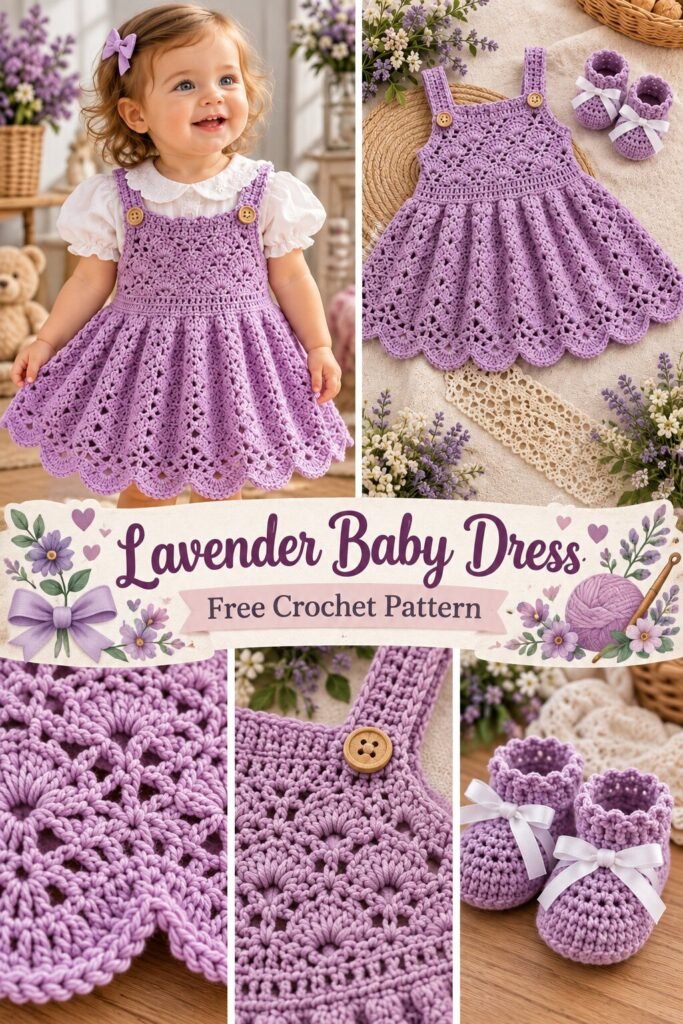
A fitted bodice worked in a shell-stitch fan pattern, wide straps closing over wooden buttons, and a seam at the natural waist dropping into a full, swingy skirt built from a lacy diamond-mesh shell repeat, finished in a deep scalloped hem. It’s worn here over a puff-sleeve blouse, the way a true pinafore is meant to layer, and a matching pair of booties with ribbon ties rounds out the set. Soft purple throughout, nothing variegated or blended — just one consistent lavender from strap to hem.
The dress reads as two distinct stitch patterns rather than one continuous repeat, and that’s worth paying attention to before you start. The bodice has a tighter, denser shell fan arrangement, while the skirt opens up into a noticeably larger-scale diamond lace. That shift happens right at the waist seam, which is also doing the practical job of controlling where the fullness begins — everything above it fitted, everything below it free to flare.
This one suits someone who’s made a baby garment or two already and wants to move from basic shaping into actual lace pattern work, since the skirt stitch is clearly more involved than a beginner repeat.
Why the Two-Stitch Approach Makes Sense
Looking at the bodice closely, the shell pattern there is tight and compact — multiple stitches fanning from single points, packed close enough to make a fairly solid fabric rather than an open one. That’s a sensible choice for a bodice, since a baby pinafore needs some structure to hold its shape over the shoulders and chest rather than sagging.
The skirt pattern is a different animal. It opens into a clear diamond-shaped mesh with shell clusters sitting inside each diamond, which is what gives the skirt its movement and the dress its characteristic swing. A dense stitch down the skirt would have made for a stiff, costume-like dress instead of the soft, twirl-friendly one shown here.
The scalloped hem border is a small thing but it matters: without it, the diamond lace would just end abruptly at a straight edge, which would look unfinished next to a bodice with this much pattern detail up top.
Materials You’ll Need
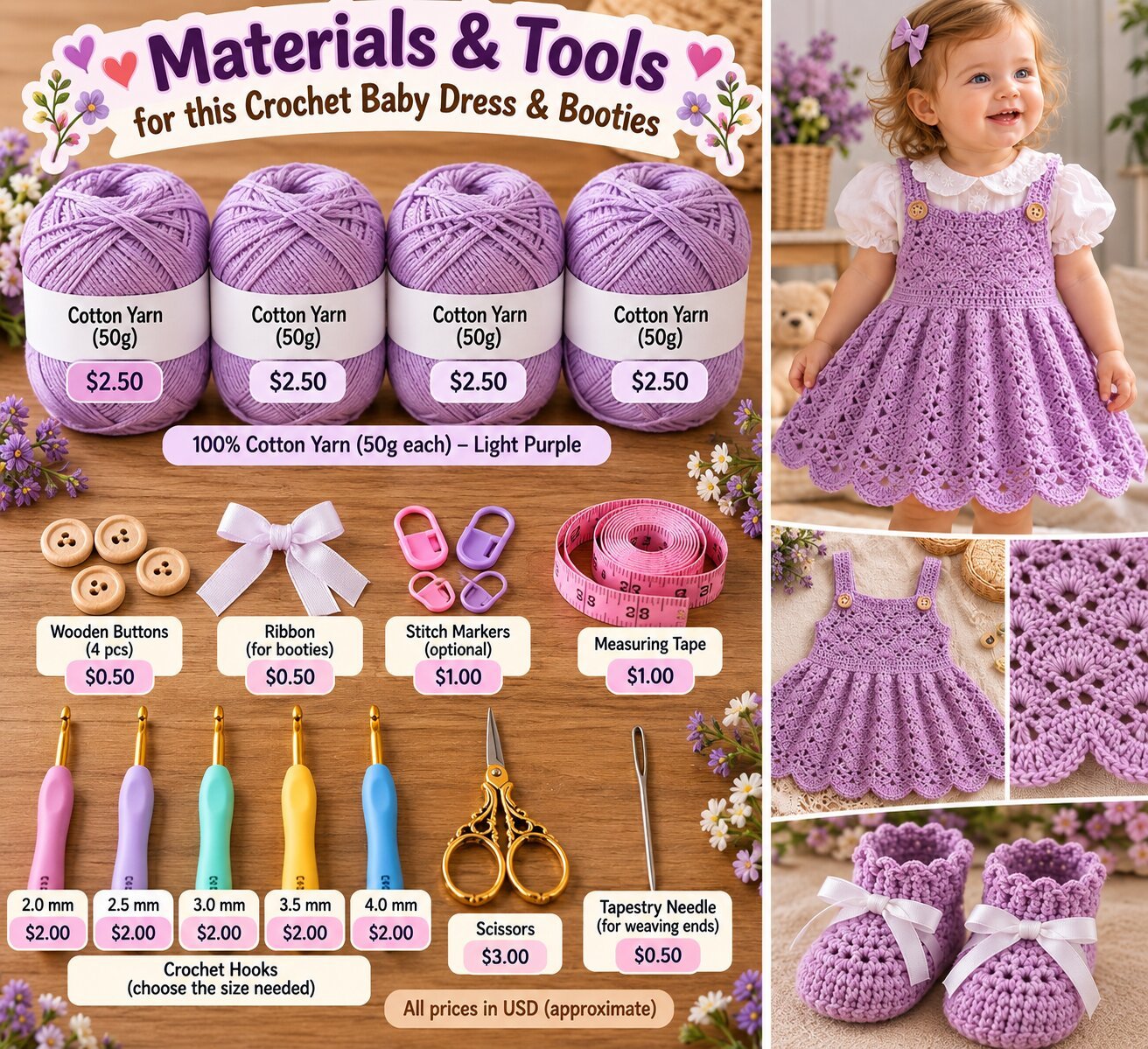
- Lavender or light purple yarn, enough to cover a baby-sized bodice and full skirt (a soft cotton or cotton-blend baby yarn is a reasonable suggestion, since the stitch definition in the photo looks crisp rather than fuzzy, and babies need something gentle against skin)
- Two wooden buttons for the shoulder straps
- A crochet hook sized to your yarn (see below)
- Yarn needle, for seaming the bodice to the skirt and weaving in ends
- Scissors
- Stitch markers, useful for keeping the diamond repeat aligned across rounds
- A tape measure or a baby sizing chart for reference, since there’s no official size chart to go by here
- White ribbon, if making the matching booties
Yarn and Hook Notes
Given how clearly defined the shell clusters and diamond spaces are in the photo, a DK or light worsted weight cotton is a sensible starting point — fine enough for baby-scale proportions, but substantial enough that the lace pattern doesn’t disappear into mush. A hook somewhere around 3.5mm to 4mm is reasonable for that weight, though as always, swatch both the bodice shell pattern and the skirt diamond pattern separately before committing, since they likely need slightly different tension to look their best.
Cotton is worth prioritizing here over acrylic for a baby piece specifically — it breathes better, washes easier, and tends to hold its shape under repeated laundering, which a baby garment will see a lot of.
Skill Level
This is a confident intermediate project. The shaping itself — a fitted bodice narrowing to a waist seam, then flaring into a skirt — isn’t complicated on its own. What raises the difficulty is the lace repeat in the skirt, which needs the stitch count to stay consistent across every round so the diamonds line up rather than drifting out of alignment as the piece grows. Someone who’s only worked solid single or double crochet fabric before will find the lace repeat a genuine step up, though nothing here requires advanced garment construction skills.
Stitches Likely Involved
- Chain (ch) — foundation rounds and the spaces that form the diamond lace
- Slip stitch (sl st) — joining rounds and finishing the waist seam
- Single crochet (sc) — likely used for the firm strap sections and waistband
- Double crochet (dc) and treble crochet (tr) — building the shell clusters in both the bodice and skirt patterns
- Shell stitch — the compact fan repeat in the bodice and the larger shell clusters inside each skirt diamond
- Increase (inc) — essential at the waist transition, since the skirt needs considerably more stitches around than the bodice to achieve that flare
- A scalloped edging technique for the hem, likely built from shell stitches worked along the final round
Building It: A Practical Sequence
Start with the bodice, worked flat or in the round depending on preference, establishing the shell fan pattern across the chest first since this sets the finished width at the top of the dress. Work the straps as an extension of the bodice back, sized to cross over the shoulders and meet the button closures at front.
Add the buttonholes or button loops on the straps before moving on, since these are much easier to place accurately while the strap is still a small, manageable piece rather than attached to a full garment.
Work a solid waistband row to transition from the bodice to the skirt. This is the natural place to do your big increase round, since you need considerably more stitches in circulation for the skirt’s diamond lace to have room to open up.
Begin the diamond lace pattern, repeating the shell-and-mesh motif evenly around. Use stitch markers at the start of each diamond repeat for the first few rounds until the rhythm becomes familiar — this pattern is exactly the kind where it’s easy to lose your place.
Continue down to the desired skirt length, checking the hang periodically against a reference baby size or an existing garment, since there’s no official chart to confirm length against.
Finish with the scalloped border, working shell stitches along the final round to create the rounded, lettuce-like edge visible at the hem.
Weave in ends and block the skirt flat, pinning the scallops out if needed — lace patterns like this almost always look better after blocking, since it opens up the diamond spaces that tend to look a little scrunched straight off the hook.
Adjusting the Fit and Look
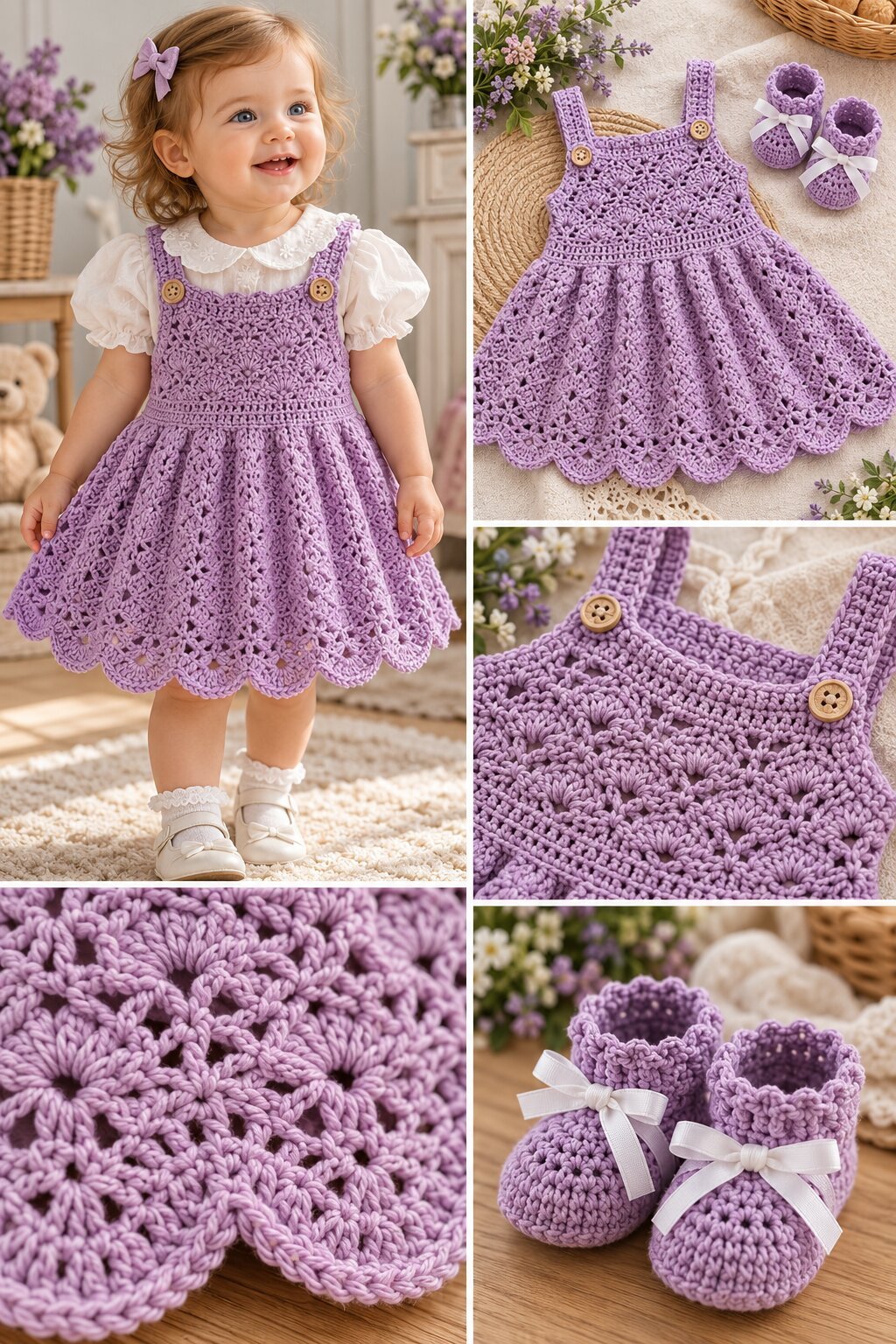
Sizing for a baby garment really comes down to comparing your gauge swatch against an existing well-fitting dress or a standard baby measurement chart, since there’s no printed pattern to lean on here. Work the bodice chest width first and check it against that reference before moving into the skirt.
Skirt length is simple to adjust — work additional lace diamond rounds for a longer hem, or stop a round or two earlier for something shorter and easier to move around in. If the shell bodice pattern feels like too much for a first attempt, a plain single or double crochet bodice with the diamond lace skirt kept as-is would still produce a very similar-looking dress with less technical demand up top.
Where It’s Easy to Go Wrong
Losing the diamond repeat partway through. Because this pattern depends on a consistent stitch count per repeat, it’s easy to drift off by a stitch or two without noticing until several rounds later, at which point the diamonds stop lining up vertically. Mark the start of each repeat and check your count every few rounds.
An uneven increase round at the waist. If the increases aren’t spaced evenly around the waistband, the skirt will flare unevenly, bunching more on one side than the other. Space your increases out mathematically rather than by eye.
Button placement that doesn’t match strap length. Since this is adjustable to your own baby’s measurements, placing the button before confirming the strap actually reaches comfortably over the shoulder can mean redoing the closure later. Try the bodice on or against a reference before finalizing the button position.
Skipping blocking on the skirt. Lace patterns like this diamond repeat often look tight and a little lumpy right off the hook. Blocking the skirt flat is what actually makes the diamonds and scallops read clearly.
Care
Hand washing in cool water and laying flat to dry is the gentler approach for a baby garment like this, especially with wooden buttons that won’t hold up well to a washing machine’s agitation. Avoid high heat entirely when drying, since it can shrink cotton and distort the lace stitch definition. Always check the yarn label for fiber-specific care, since cotton, acrylic, and blended yarns can behave differently under heat and washing.
Common Questions
Is this a good first baby garment to crochet?
It’s better suited as a second or third baby project rather than a true first attempt, mainly because of the diamond lace repeat in the skirt, which takes more attention than a plain stitch pattern.
What yarn works best for a baby pinafore like this?
A soft cotton or cotton-blend in DK or light worsted weight is a practical suggestion, since it holds the lace stitch definition well and launders easily, which matters for baby clothing.
Can I make this in a different color?
Yes, the construction works the same regardless of color — soft pastels or a deeper jewel tone would both suit this style depending on the occasion.
Do I need to block this dress?
Blocking is likely to improve it noticeably, particularly the skirt’s diamond lace and scalloped hem, both of which tend to look tighter and less defined straight off the hook.
Can I make matching booties without a separate pattern?
The booties shown use a similar shell-stitch texture to the bodice, so working a small round shell-stitch sole and upper, finished with a ribbon tie, would likely produce a visually coordinated pair.

