
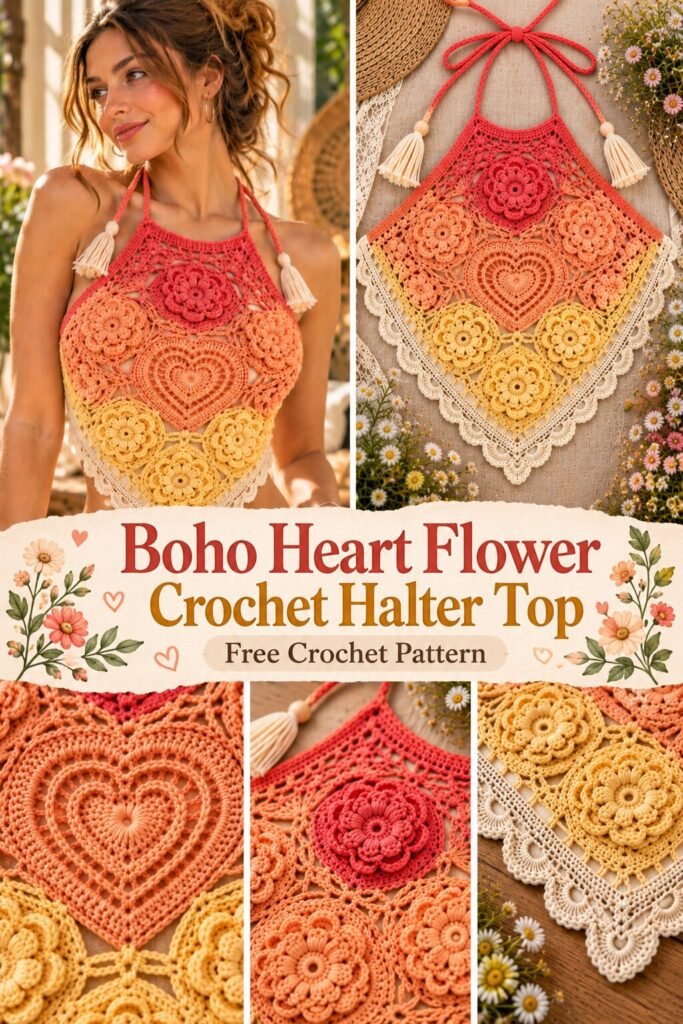
A single deep coral rose sits right at the neckline of this halter, and everything cascades from there. Below it, a heart worked in a softer terracotta tone, then a pair of flowers in warm peach, another band in golden yellow, and finally a scalloped cream lace edge closing out the point of the triangle. The straps are simple crocheted cords, each finished with a small tassel, crossing behind the neck rather than a fitted back panel.
What makes this one worth studying isn’t the halter shape itself, which is common enough in crochet garment design. It’s the way color does the storytelling here. Instead of a solid-colored top with decoration layered on, the gradient and the motifs are working together, so the piece reads as a single sunset image rather than a top with flowers stuck on it. That takes some planning before you ever pick up a hook.
Anyone who enjoys motif crochet more than long rows of plain fabric will likely be drawn to this. It also rewards people who like fussing over color order, since getting the gradient to feel smooth rather than choppy is really the whole game.
Why This Design Works
The gradient placement follows the shape of the triangle logically: darkest at the narrow top, lightest at the wide bottom, which is a natural way to let a color transition read clearly on a triangular garment. A gradient that ran the opposite direction, or side to side, would fight the shape instead of working with it.
The heart motif breaks up what would otherwise be four flower shapes stacked in a column. Without it, the eye would just slide down the same repeated motif; with it, there’s a pause, a different silhouette in the middle of the sequence.
The scalloped cream border at the bottom is doing more than finishing the edge. It’s the one neutral element in an otherwise saturated piece, and it gives the eye somewhere to land before the top ends. A border in one of the gradient colors would have blurred that stopping point.
Materials You’ll Need
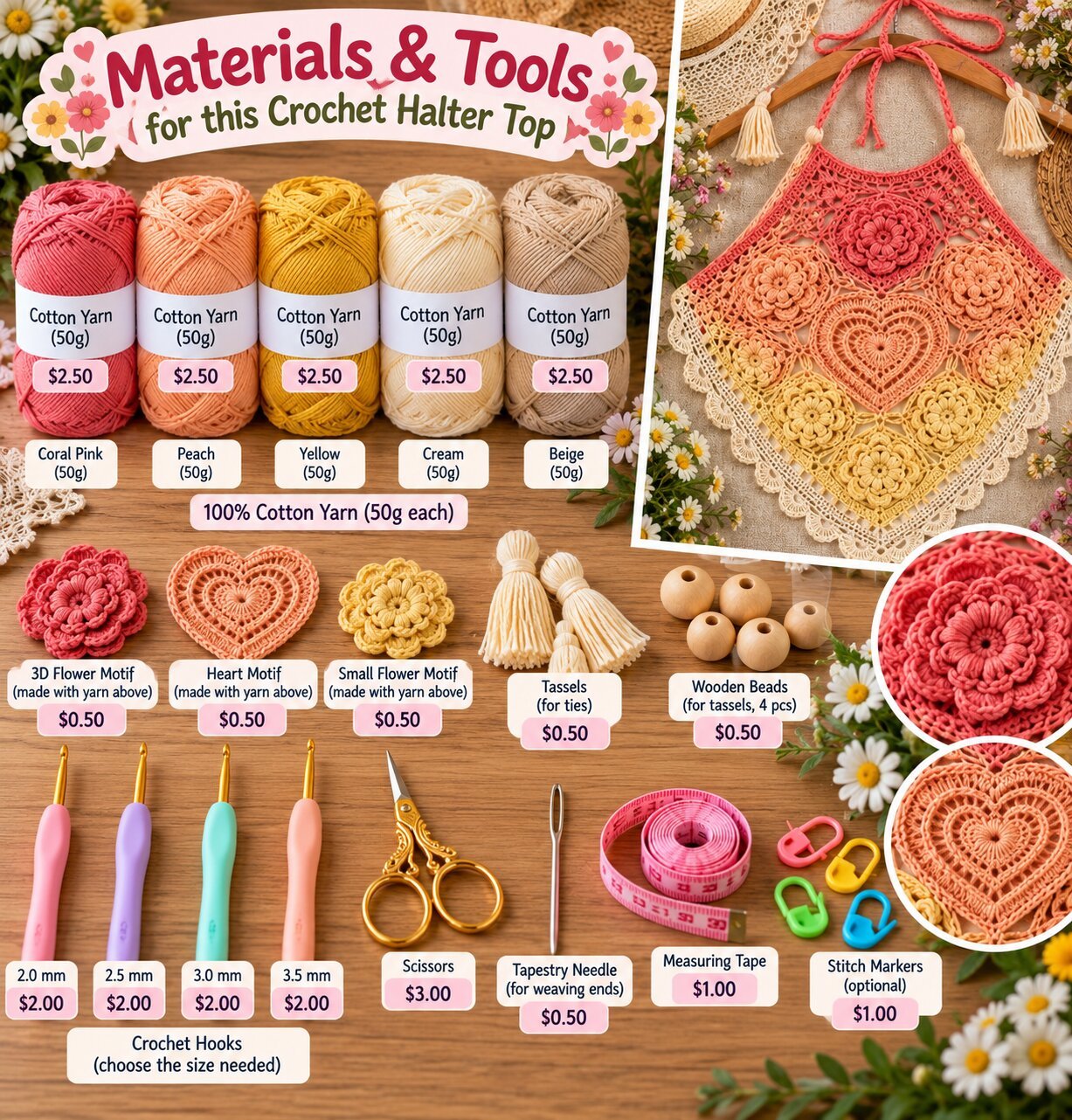
- Yarn in four to five coordinating shades moving from deep coral through peach, orange, and gold (a cotton or cotton-blend yarn is a reasonable starting suggestion, since it holds shape well in motif work)
- A smaller amount of cream or off-white yarn for the border
- A crochet hook sized to your yarn (see below)
- Yarn needle for joining motifs and weaving in ends
- Scissors
- Stitch markers, useful for tracking motif placement rather than rows
- A tape measure, since fit here depends on your own chest measurement rather than a printed size chart
Yarn and Hook Notes
Based on how tightly formed the petals and the heart’s outline appear, a fingering to light DK weight cotton would get you into a similar scale without the motifs turning bulky. A hook somewhere in the 2.75mm to 3.5mm range is a sensible starting point for that weight, though this is exactly the kind of project where you want to swatch a single flower first and see how it sits before committing to a whole set.
If your gauge runs looser than average, sizing down a hook step will help keep the petal edges from going floppy. If it runs tight, sizing up slightly can open the mesh background enough that it doesn’t feel stiff against the body.
Skill Level
This sits in intermediate to advanced territory, not because any single technique is hard on its own, but because of what’s being asked of the crocheter simultaneously: dimensional flower construction, a shaped heart motif, color sequencing across multiple pieces, and then assembling all of it into a garment that still needs to fit. Someone who has made a granny square blanket but never a fitted top, or someone who’s made simple tops but never a layered flower, will both find something new here.
Stitches Likely Involved
- Chain (ch) — foundation rounds and the mesh background between motifs
- Slip stitch (sl st) — joining rounds, finishing off motifs cleanly
- Single crochet (sc) — compact rounds, possibly part of the border
- Double crochet (dc) and treble crochet (tr) — the taller stitches that would give the outer petal layers their reach
- A layered petal construction for the flowers — worked in rounds with each layer’s petals set behind the previous one, which is what creates that stacked, dimensional look rather than a flat rosette
- A two-lobed heart shape, narrowing to a point at the bottom, with what looks like a raised or doubled outline running around the edge
- Shell or picot stitching for the scalloped border, since either would produce that repeating scalloped edge along the hem
None of this is confirmed as the exact original method. It’s what would reasonably get you to a similar result.
Building It: A Practical Sequence
Start with the motifs, not the background. Make the flowers and the heart first, as separate pieces. This lets you see your actual colors side by side before they’re locked into a garment, which matters more here than in most projects.
Work the mesh triangle next. A simple chain-space mesh, increased evenly on both sides as you move down from the neckline, gives you the open background these motifs are sitting on. Match your color changes in the mesh to where each motif will land, so the transition feels continuous instead of the motifs looking pasted onto a background that’s doing its own thing.
Fit before you finish shaping. Since there’s no official size chart to fall back on, try the mesh against your own chest periodically as you widen it. It’s much easier to add a round now than to unpick a finished border later.
Attach the motifs in the arrangement you laid out. Stitch each one down securely around its base rather than at a few tack points, since a piece with this many individual attachments is more likely to shift with wear if the joins are minimal.
Work the border last, after everything is attached. The scalloped cream edge reads best when it’s framing a finished front rather than being blocked separately and joined on afterward.
Add the ties and tassels, then block the whole thing. Blocking matters more here than in a solid-color top — it’s what will make the petals sit open and flat rather than curled, and what will get the scallops along the hem lying evenly instead of puckering.
Adjusting the Fit and Look
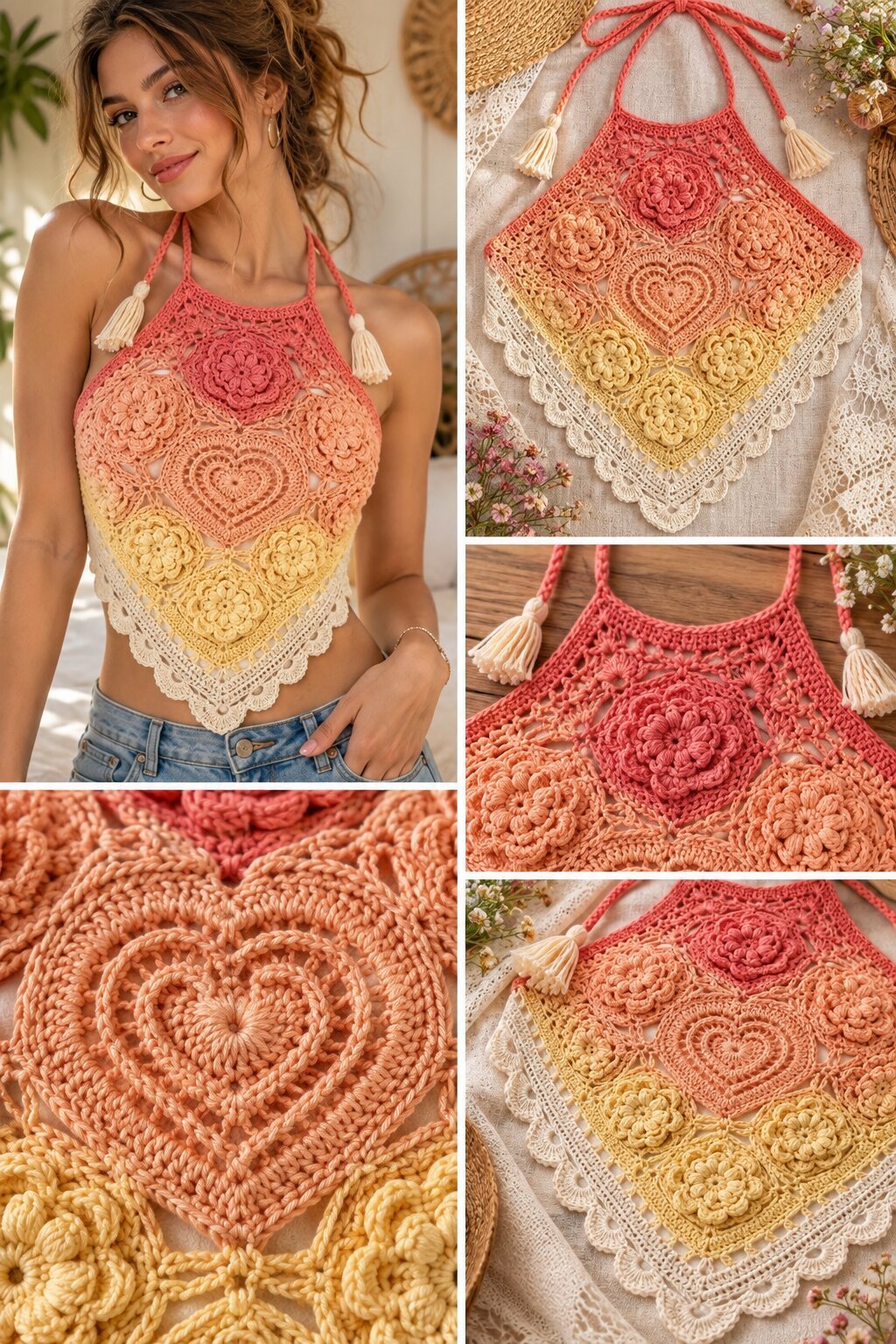
Because sizing isn’t fixed by a pattern here, width and length both come down to your own chest measurement and how far down the torso you want the point of the triangle to fall. Add rounds to the mesh for more length or width; work fewer for a cropped, higher silhouette.
The gradient sequence is also flexible. A cooler run of colors, blues into lavender, would keep the same construction but shift the whole mood of the piece toward something better suited to a different season. Reducing the flower count to just the top motif and the heart, skipping the lower pair entirely, would simplify the project considerably for a first attempt at this style.
Where It’s Easy to Go Wrong
Uneven petal layers. If one flower’s outer round has noticeably tighter stitches than another’s, they’ll read as different sizes once placed side by side. Keep tension consistent flower to flower, not just within one.
A gradient that jumps instead of flows. Skipping a shade, or spacing the color changes unevenly across the mesh, breaks the sunset effect the whole design depends on. Plan the color order before starting, not as you go.
Skipping blocking on the motifs. Petals that aren’t blocked tend to curl at the tips rather than lying flat, which flattens the dimensional look that’s the whole point of layering them.
Attaching motifs at only a few points. This looks fine at first, then starts to shift after a few wears. Stitch around more of the motif’s edge than feels necessary.
Care
Hand washing in cool water and laying flat to dry is the safer approach for a piece with this many joined motifs, particularly if you’ve used cotton. Skip the dryer, since heat can flatten the raised texture on the flowers and heart that took the most effort to build in the first place. Check the specific yarn label for anything more particular to that fiber.
Common Questions
Is this a good first motif project?
Not really the best starting point. A single layered flower or a simple granny square is a gentler way to build the skills this halter asks for before combining them all at once.
Can I use a different fiber than cotton?
Yes, though a fiber with more give, like a wool blend, may make the petals harder to keep crisp. Cotton’s structure is part of why it’s suggested here.
What if I only want two colors instead of four?
That works, though the piece will read as color-blocked rather than gradient. The transition is smoother with more, closely related shades rather than fewer, more contrasting ones.
Do the ties need to be exactly as long as shown?
No — tie length is one of the easiest things to adjust based on how you want it to sit and tie behind your neck.

